About the Piece
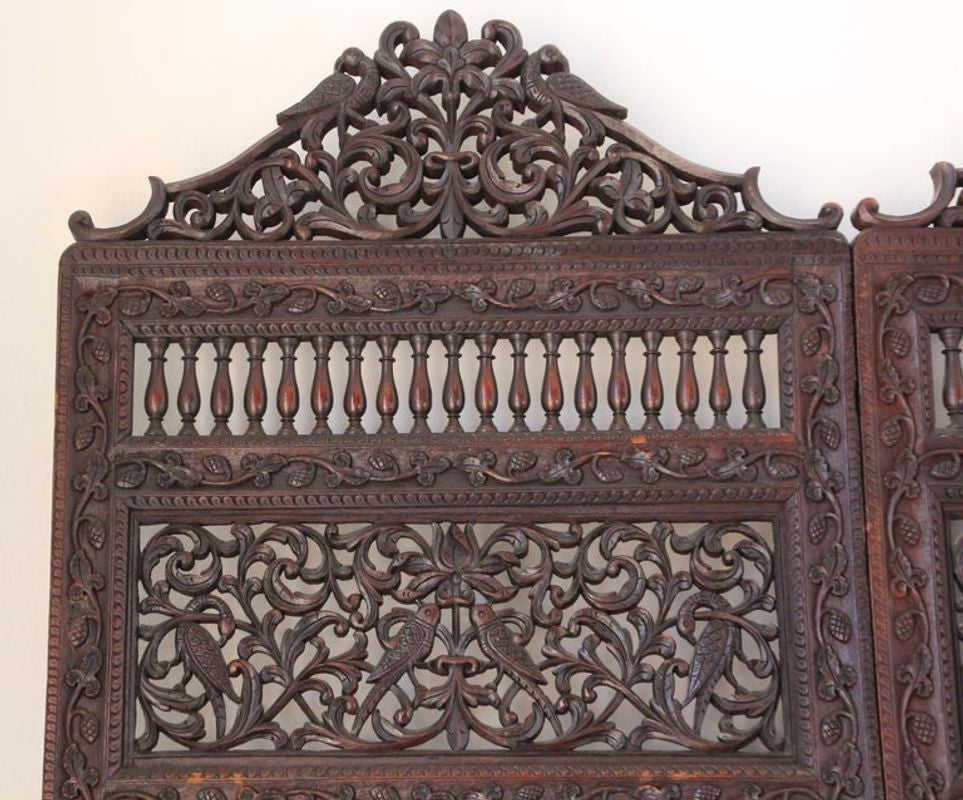
An exceptional late 19th-century Anglo-Indian three-panel folding screen, circa 1880, profusely hand-carved and pierced in hardwood with elaborate Mughal-inspired floral, foliate, bird and architectural motifs. Monumental yet remarkably delicate in appearance, this highly decorative screen exemplifies the virtuosity of Indian carving produced during the British Raj. The screen consists of three hinged panels, each measuring approximately 67 inches high × 19.5 inches wide, creating an overall width of approximately 60 inches when fully extended. Its tall, narrow proportions and extraordinary density of openwork give the piece a strong architectural presence while allowing light to pass through the carving. Each panel is crowned by an elaborate pierced crest composed of scrolling foliage and stylized avian decoration. Below, the composition is organized into successive registers of intricately carved openwork. Dense arabesque and floral panels alternate with pairs of slender Mughal and Moorish-style cusped arches, creating a rhythmic architectural pattern from top to bottom. Of particular interest is the extensive pierced lattice or pinjra work. Derived from the Persian and Hindustani term associated with cage or lattice construction, this type of finely pierced woodworking became an important element of architectural and decorative carving in northern India. Here, the technique creates an almost lace-like effect, contrasting beautifully with the substantial dark hardwood framework. The carved decoration draws upon the rich vocabulary of Mughal Indian design, combining scrolling vines, stylized flowers, birds, geometric borders and cusped architectural arches. The dark reddish-brown surface and naturally developed patina further emphasize the depth of the carving and give the screen considerable sculptural character. Although originally conceived as a folding room divider or privacy screen, the piece offers numerous possibilities in a contemporary interior. It could stand as an architectural screen in a large living room, entry or bedroom, or be displayed more sculpturally as wall decoration or an impressive king-size headboard, particularly in a sophisticated layered interior combining antique and modern furnishings. The screen is in excellent antique condition for its age, with a stable structure and attractive surface patina consistent with a piece dating from the late 19th century. A related Anglo-Indian carved screen is documented in Amin Jaffer's important reference, Furniture from British India and Ceylon, pages 308–309, in connection with an example in the Victoria and Albert Museum collection. I would present this strictly as a scholarly stylistic reference, rather than implying that the Mosaik screen is identical to or directly associated with the museum example. Dimensions: Each panel approximately 67" H × 19.5" W. Overall approximately 67" H × 60" W when extended. Origin: Northern India Period: Late 19th Century Date: Circa 1880 Style: Anglo-Indian / Mughal / British Colonial Materials: Carved hardwood Techniques: Hand-carved, pierced, openwork, fretwork Form: Three-panel hinged folding screen Condition: Excellent antique condition with age-appropriate wear and patina.