About the Piece
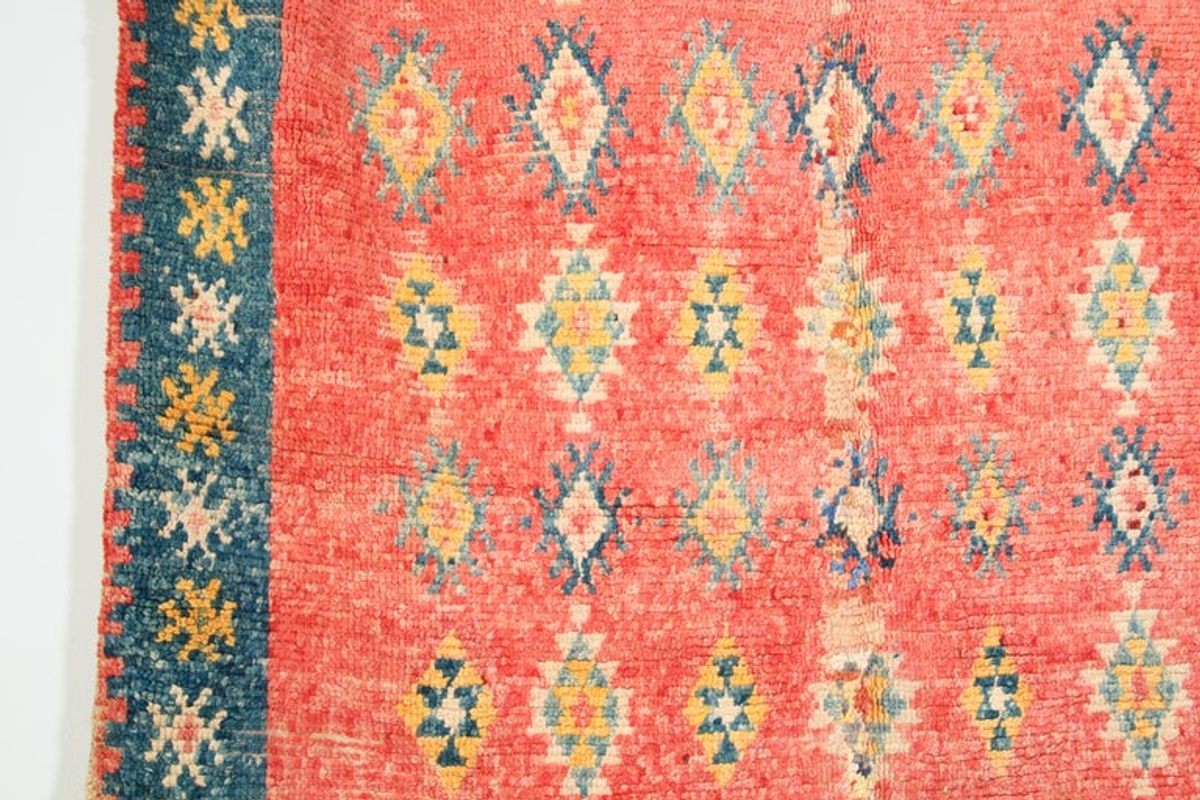
An authentic vintage Moroccan Berber tribal rug, handwoven in Morocco during the mid-20th century, circa 1960s. Measuring 58 inches wide by 116 inches long—approximately 4 feet 10 inches by 9 feet 8 inches—this one-of-a-kind North African textile features a beautifully aged coral-red field surrounded by a deep muted blue-green and teal border. The rug’s central field is organized into rhythmic rows of handwoven geometric motifs, including diamonds, lozenges, crosses and abstract tribal forms. These decorative elements appear in softened shades of teal, turquoise, mustard yellow, pale ivory, dark blue and muted red. The surrounding border presents a repeated pattern of small cross-shaped motifs that frames the composition and gives the rug a strong architectural structure. Natural fading has softened the original colors, creating the nuanced coral, teal and ochre palette visible in the photographs. This authentic age-related variation gives the rug depth and character while allowing it to work beautifully in both traditional and contemporary interiors. The more accurate colors are shown in the newly photographed hero image and should be used as the reference when describing the rug. Hand-knotted and handwoven by Berber artisans, the rug has a relatively low wool pile with an expressive, tactile surface. The listed materials include wool and goat hair, while the documented techniques include hand-knotting, hand-weaving and vegetable dyeing. Subtle variations in the weaving, motif placement, edges and coloration are characteristic of individually handcrafted Moroccan rugs and contribute to the rug’s genuine tribal character. The geometric vocabulary and low-pile construction relate stylistically to Beni M’Guild and other Middle Atlas Berber weaving traditions. Because a specific tribal provenance has not been independently documented, Beni M’Guild is best presented as a stylistic attribution rather than a definitive origin. The listed creator is the Berber Tribes of Morocco, identified as the weaver, and the place of origin is Morocco. Repeated diamond and lozenge forms are frequently encountered throughout Moroccan Berber weaving. While such motifs are often associated with protection, family, fertility and the natural world, their precise meanings can vary between individual weavers, communities and generations. Here, the repeated forms create an engaging visual rhythm that gives the rug the presence of an abstract work of Folk Art. Its elongated proportions make this vintage Moroccan rug especially versatile. At just under five feet wide and nearly ten feet long, it can be used as a substantial hallway or gallery rug, positioned in front of a bed, placed alongside a dining table or used to define a compact seating arrangement. Its coral-red field adds warmth, while the teal border provides contrast and a sophisticated sense of depth. This vintage Berber rug would complement Wabi-Sabi, Organic Modern, Mid-Century Modern, Mediterranean, Bohemian, Tribal, Folk Art, eclectic and contemporary interiors. It works particularly well with lime-plaster walls, aged wood, linen, leather, limestone, travertine and other natural materials. The rug is presented in good vintage condition, with wear consistent with age and previous use. Minor fading, surface variation, areas of lower pile and age-related irregularities are visible and form part of its authentic character. Please review all photographs closely for the best understanding of the color, pile, edges, fringe and overall condition. Creator: Berber Tribes of Morocco, weaver. Place of origin: Morocco. Period: Mid-20th Century. Date: circa 1960s. Materials: wool and goat hair. Techniques: hand-knotted, handwoven and listed as vegetable-dyed. Style: Tribal or Folk Art, with a Beni M’Guild-style attribution. Dimensions: 58 inches wide by 116 inches long.